


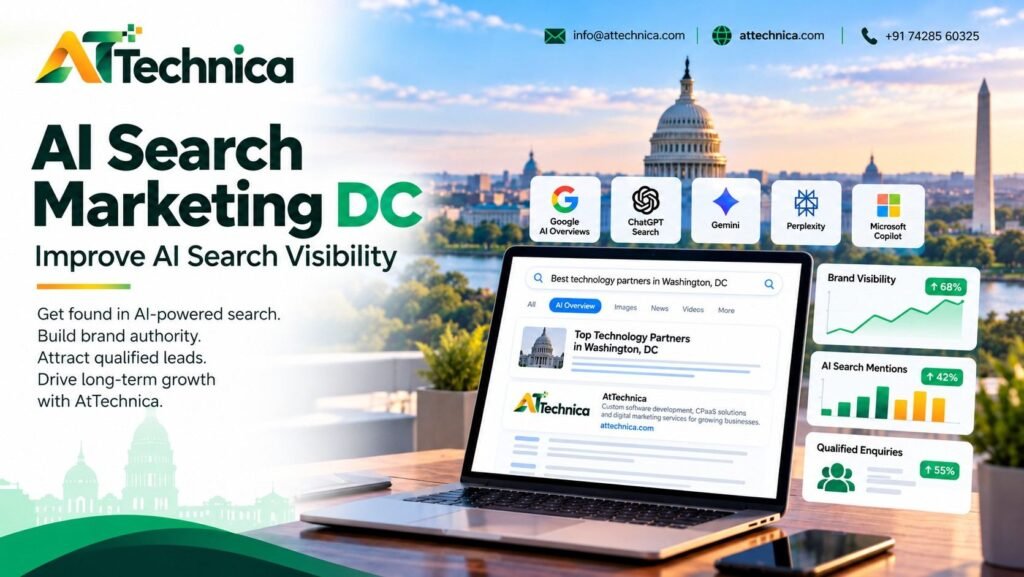
AI Search Marketing DC helps businesses improve how they appear across traditional search engines and AI-powered search experiences. For companies in Washington, DC, this means making their services easier to discover, their expertise easier to understand, and their business information easier to verify.
Customers increasingly use Google, ChatGPT, Microsoft Copilot, Gemini, and Perplexity to research services, compare vendors, and explore solutions. These platforms do not all work alike, and appearing in one does not guarantee visibility in another. However, businesses can strengthen their foundations through technical SEO, helpful content, credible external references, and accurate company information.
For technology providers, SaaS businesses, consultants, nonprofits, and enterprise vendors, AI Search Marketing DC is particularly relevant when prospective customers research a solution before contacting a sales team.
AtTechnica combines CPaaS solutions, software development, and digital marketing services. These capabilities can support a connected growth strategy, from improving online discoverability to building digital experiences and managing customer communication.
This guide explains how AI search optimization works, what Washington, DC businesses should prioritize, and how to measure progress without relying on unsupported ranking promises.
What Is AI Search Marketing?
AI search marketing is the practice of improving a business’s discoverability and representation across AI-powered search experiences and conventional search engines.
These experiences may provide AI-generated summaries, source links, conversational answers, or recommendations. Depending on the platform and query, users may see different businesses, sources, and explanations.
A practical AI Search Marketing DC strategy includes five areas:
- Technical SEO: Make important pages accessible, crawlable, indexable, and easy to navigate.
- Content optimization: Answer customer questions with accurate, useful, and original information.
- Brand authority: Build a credible presence through relevant publications, professional profiles, partnerships, and genuine references.
- Entity clarity: Explain what your company does, whom it serves, which services it provides, and where it operates.
- Performance measurement: Monitor search performance, AI visibility observations, qualified enquiries, and conversions.
AI search marketing is not the same as AI-generated advertising. Paid search campaigns use advertising placements, while organic AI search optimization focuses on discoverability and how information about a business is represented.
What are GEO and AEO?
Generative Engine Optimization (GEO) is an industry term for improving visibility in generative AI experiences. Answer Engine Optimization (AEO) generally focuses on content that helps answer engines provide direct responses.
Definitions overlap, and neither term represents a universally standardized ranking system. Businesses do not need a separate set of unverified tricks to succeed in AI search.
Google’s official guidance on AI search features explains that established SEO fundamentals remain important for eligibility in AI Overviews and AI Mode.
Read Other Blogs
- WhatsApp Business Use Cases for Supermarkets — Explore how messaging can support customer engagement.
- AtTechnica’s digital marketing resources — Explore the company’s broader technology and marketing capabilities.
Why AI Search Marketing DC Matters for Washington, DC Businesses
Washington, DC serves a varied business community that includes technology providers, consulting firms, professional services, associations, nonprofits, educational institutions, and government-adjacent vendors.
These organizations often need to establish credibility before a prospective customer makes contact. A buyer may research a software company, compare implementation partners, investigate a consultant, or ask an AI assistant to explain which solution fits a specific business requirement.
AI Search Marketing DC helps address this discovery challenge by focusing on the quality, accessibility, and credibility of the information available about a business.
Local discovery and geographic relevance
Consider a hypothetical customer searching for a professional service provider near Capitol Hill or a business looking for technology support in Georgetown. Clear service descriptions and accurate geographic information can help people understand whether a provider is relevant to their needs.
Washington, DC proper is not interchangeable with Arlington, Alexandria, or Bethesda. Businesses targeting the wider DMV region should distinguish their actual service areas and avoid claiming local offices they do not have.
For eligible local businesses, a complete and accurate Google Business Profile can support local discovery. Keep business categories, operating hours, service details, and contact information current. Follow Google’s Business Profile guidelines and collect genuine customer reviews without incentives or manipulation that violate platform policies.
B2B discovery and vendor evaluation
B2B buyers often ask more detailed questions than consumers. Examples include:
- Which software development company can integrate a CRM with existing business systems?
- What should an enterprise consider before selecting a CPaaS provider?
- How can a SaaS business improve its organic visibility and lead generation?
- Which digital marketing services support qualified B2B enquiries?
A well-structured website should answer these questions directly, explain the relevant capabilities, and give buyers enough information to evaluate the offering.
This is where AI Search Marketing DC extends beyond local SEO. It combines geographic relevance, when appropriate, with technical expertise, clear positioning, and content that supports complex buying decisions.
SEO vs. GEO vs. AEO vs. AI Search Marketing
| Approach | Main objective | Common activities |
|---|---|---|
| Traditional SEO | Improve organic search discoverability | Technical SEO, content, internal linking, indexing |
| GEO | Improve discoverability in generative AI experiences | Helpful explanations, original insights, credible references |
| AEO | Make content useful for direct-answer experiences | Question-led content and clear answers |
| AI search marketing | Coordinate visibility across AI-powered search experiences | SEO, content, reputation, testing, and conversion measurement |
These approaches overlap considerably. Technical SEO, useful content, and credible information remain valuable across conventional search and many AI search experiences.
Google’s SEO Starter Guide is a useful foundation for businesses beginning an AI search optimization program.
How AI Search Systems Discover and Represent Businesses
Different AI platforms use different retrieval, synthesis, and selection processes. Their exact mechanisms are not fully public, and no universal checklist guarantees a business will be mentioned.
Still, a few practical areas deserve attention.
Technical accessibility
Important pages should be crawlable, return appropriate status codes, use correct canonical URLs, and have useful internal links. Avoid accidentally blocking relevant content or relying on pages that search engines cannot access.
For Google AI search experiences, eligibility depends on meeting the applicable Search requirements. Google does not guarantee that every eligible page will be crawled, indexed, or shown.
Clear business information
Explain the company’s services, products, expertise, target industries, and operating locations consistently. Avoid vague claims such as innovative technology solutions without describing what the business actually provides.
Credible external information
Professional profiles, relevant industry publications, genuine partner references, and reputable directories can help people evaluate a company’s expertise. These references should be earned and accurate, not manufactured to create the appearance of popularity.
Appropriate structured data
Structured data can help search engines interpret information about a page or organization. Use relevant markup that matches the visible content and validate its implementation.
However, adding schema does not guarantee an AI citation or recommendation. Review Google’s structured data documentation before implementing it.
The AI Search Marketing DC: Visibility Framework for DC Organizations
AtTechnica recommends an eight-part working framework for businesses planning an AI Search Marketing DC strategy. This is a practical model, not an official framework from a search platform.
| Component | Business problem | Recommended action |
|---|---|---|
| Entity clarity | Buyers misunderstand the offering | Standardize company and service descriptions |
| Technical accessibility | Pages are difficult to discover | Audit crawling, indexing, internal links, and canonical tags |
| Answer-first content | Customers cannot find direct answers | Answer the main question early, then explain the details |
| Topical expertise | Content lacks useful depth | Publish original guides, comparisons, and implementation resources |
| Authority and reputation | Claims are difficult to verify | Earn relevant references and maintain accurate profiles |
| Local relevance | Geographic coverage is unclear | Describe genuine service areas and eligible local listings |
| Conversion infrastructure | Visitors struggle to enquire | Improve forms, calls to action, and CRM workflows |
| Measurement | Rankings alone do not show business value | Track visibility, traffic, qualified enquiries, and conversions |
The framework connects search visibility with the customer journey. A business mention is more useful when the visitor can reach a relevant service page, understand the offering, and take a clear next step.
Read Other Blogs
- AtTechnica’s blog and technology resources — Browse published content relevant to technology and digital marketing.
Practical AI Search Marketing DC Strategies
The best starting point is a prioritized plan that addresses technical barriers before expanding content production.
Step 1: Test real customer questions
Create a list of questions your customers ask during research and sales conversations. Examples include:
- How can a B2B technology company improve AI search visibility?
- What should businesses consider when choosing a CPaaS platform?
- How can a company improve its visibility in Google AI search?
- What is the difference between GEO, AEO, and traditional SEO?
Test the same prompts across relevant platforms. Record brand mentions, citations where available, competitors, source links, and inaccurate descriptions.
These observations are directional, not definitive rankings. Responses can vary between sessions and over time.
Step 2: Audit technical SEO
Review indexing, crawl errors, XML sitemaps, internal links, canonical tags, mobile usability, page performance, and structured data.
Use Google Search Console for Google search performance and indexing diagnostics. Use Bing Webmaster Tools for Bing-related website and search performance insights.
Step 3: Improve service pages
Give each major service a clear, dedicated page. Explain what the service includes, who it serves, which problems it solves, and how implementation works.
For a software development company, describe application types, API integration, project stages, and technical dependencies. For a marketing provider, distinguish technical SEO, content marketing, paid media, and conversion optimization.
Step 4: Publish useful, answer-led content
Create guides that address customer questions, buying objections, implementation requirements, and practical comparisons.
Useful formats include troubleshooting guides, industry-specific use cases, API documentation, service comparisons, pricing-factor explainers, and implementation checklists.
Google’s guidance on generative AI content emphasizes accuracy, relevance, and user value. AI tools can support content production, but generic pages without meaningful original value are not a sustainable strategy.
Step 5: Build legitimate authority
Contribute useful expertise to relevant publications, professional communities, industry events, and partner resources. Keep public company information consistent and pursue genuine references.
Avoid fabricated reviews, artificial brand mentions, misleading directory listings, or unsupported claims of market leadership.
Step 6: Improve local relevance where applicable
Maintain accurate local business information and develop location-specific pages only when they provide genuine value. Follow Google’s eligibility policies and never invent offices or create doorway pages for locations the business does not meaningfully serve.
Step 7: Connect visibility to conversions
Check whether service pages have clear calls to action, forms work correctly, and enquiries reach the right team. A discoverable website should also make it easy for interested visitors to request a consultation, ask a question, or book a demo.
Prioritization table
| Action | Purpose | Indicative effort | Measurement |
|---|---|---|---|
| Technical SEO audit | Remove discovery barriers | Medium | Indexing and crawl diagnostics |
| Service-page improvements | Clarify capabilities | Medium | Relevant impressions and enquiries |
| Question-led content | Address customer needs | Medium to high | Query performance and conversions |
| External authority development | Improve public credibility | Ongoing | Relevant mentions and referral traffic |
| AI prompt testing | Establish a baseline | Low to medium | Mentions, citations, and accuracy |
| Conversion improvements | Turn interest into leads | Medium | Qualified enquiry and conversion rates |
Effort varies with the website’s size, current condition, competition, and available resources.
AI Search Marketing DC for B2B, SaaS, CPaaS, and Software Companies
Technology businesses frequently sell services that require explanation. Broad positioning can leave potential customers uncertain about integrations, capabilities, implementation requirements, and technical limitations.
A strong B2B AI Search Marketing DC strategy makes complex services easier to understand without oversimplifying them.
Create use-case-specific content
SaaS companies can publish integration guides, comparison pages, product documentation, and industry-specific use cases. Software development providers can explain architecture options, API integrations, project stages, and common technical trade-offs.
CPaaS providers can describe how SMS, WhatsApp Business API, RCS, voice, and email fit into business communication workflows. Each page should state actual capabilities and limitations accurately.
Explain technical details clearly
Documentation should help both technical evaluators and business decision-makers. Explain prerequisites, supported integrations, workflows, error handling, and relevant dependencies.
For regulated or government-adjacent markets, publish security, privacy, and compliance claims only when they can be verified. Do not imply certifications or contractual qualifications that have not been established.
Demonstrate expertise with evidence
Original guides, accurate documentation, real implementation examples, and approved case studies help buyers evaluate a provider.
If a case study is published, explain the context, scope, methodology, and verified outcome. Never invent client identities, testimonials, or performance metrics.
Read Other Blogs
- WhatsApp Business Use Cases for Supermarkets — Explore business messaging use cases.
- Free SMS OTP Service Syria: Business SMS Verification with AtTechnica — Explore SMS verification and communication workflows.
How CPaaS and Software Development Support the Customer Journey
Search optimization and customer communication serve different purposes. Search helps people discover and evaluate a business, while software and messaging infrastructure can support the next steps.
Consider a hypothetical example. A buyer discovers a technology provider through search, visits a service page, and requests a demo. The website sends the enquiry to a CRM, routes it to the appropriate sales representative, and sends a confirmation through email or WhatsApp Business API.
SMS notifications may support time-sensitive updates where appropriate. Connected analytics can help the company understand which channels contribute to qualified enquiries.
AtTechnica offers CPaaS solutions, software development, API integration, and digital marketing capabilities that can support this type of connected customer journey.
Messaging automation does not independently improve AI search rankings. Its role is to support engagement, follow-up, and lead management after discovery.
Read Other Blog
- WhatsApp Business Use Cases for Supermarkets — Learn about practical messaging scenarios.
How to Measure AI Search Marketing Results
Traditional rankings are useful, but they do not show every part of the customer discovery process.
Organic search performance
Track impressions, clicks, relevant queries, landing-page performance, and indexing issues through Google Search Console. Use website analytics to review user journeys and configured conversion events.
AI visibility
For a consistent prompt set, record:
- Whether the brand is mentioned
- Whether citations or source links appear
- Which pages and external sources are referenced
- Whether the description of the business is accurate
- Which competitors are mentioned
- Whether the answer reflects the intended service and market
Repeat the same tests monthly, documenting the platform, prompt, date, and methodology.
Share of voice, share of model, and sentiment can be useful custom metrics, but their definitions must remain consistent. Third-party monitoring platforms do not provide complete access to every AI system’s internal processes.
Qualified leads and commercial outcomes
Measure identifiable AI-platform referral traffic where available, branded search trends, qualified enquiries, conversion rates, and lead quality.
More brand mentions do not automatically mean more revenue. The objective is to determine whether better discoverability helps the right audience find the business and take meaningful action.
AI Search Marketing Tools Worth Evaluating
| Tool | Main purpose | Limitation |
|---|---|---|
| Google Search Console | Organic search and indexing diagnostics | Not a complete cross-platform AI visibility tracker |
| Google Analytics | Website traffic and conversion measurement | Attribution depends on tracking configuration |
| Bing Webmaster Tools | Bing search performance and diagnostics | Does not represent every AI platform |
| Otterly.AI | AI search visibility monitoring | Coverage depends on supported platforms and methodology |
| Peec AI | AI search analytics and visibility reporting | Metrics depend on its data collection and definitions |
Review current product features, supported platforms, sampling methods, reporting options, and pricing before purchasing a monitoring subscription.
How to Choose an AI Search Marketing Agency in Washington, DC
When evaluating an agency, ask how it will implement the work and demonstrate progress.
- How will the agency establish a technical SEO and AI visibility baseline?
- Which platforms and customer prompts will it monitor?
- How will it prioritize technical fixes, content improvements, and external authority?
- Who writes, reviews, and implements the content?
- How will the agency verify claims and investigate inaccurate AI descriptions?
- What reports will you receive, and how often?
- How will leads and conversions be measured?
- Who owns the website, analytics, content, and platform accounts?
- What deliverables and implementation responsibilities are included?
- Does the agency guarantee AI citations or rankings?
Be cautious of guaranteed AI recommendations, unexplained visibility scores, fabricated case studies, and proposals focused on producing large quantities of low-value content.
A credible provider should explain what it can control, what it can measure, and what depends on independent search and AI systems. If local presence matters, confirm whether the agency has a genuine Washington, DC office or serves the market remotely.
Common AI Search Marketing DC Mistakes to Avoid
Businesses should avoid:
- Repeating the primary keyword unnaturally to achieve a target density.
- Publishing generic AI-generated content without fact-checking or original value.
- Using invented statistics, testimonials, or unsupported business claims.
- Creating fake offices, misleading listings, or fabricated reviews.
- Neglecting technical SEO, indexing, and internal linking.
- Adding structured data that misrepresents the page.
- Assuming visibility on one AI platform guarantees visibility on another.
- Reporting brand mentions without examining source accuracy or lead quality.
- Treating AI search optimization as a replacement for traditional SEO.
Google’s SEO Starter Guide provides a useful foundation for improving website discoverability.
How AtTechnica Supports AI Search and Digital Growth
AtTechnica combines technology and digital marketing capabilities that can support different stages of the customer journey.
Technical SEO and digital marketing: Improve website accessibility, content structure, organic discoverability, paid campaign performance, and conversion opportunities.
Website and software development: Build or improve websites, landing pages, applications, and integrations that help visitors understand services and take action.
CPaaS and business communication: Use SMS, WhatsApp Business API, RCS, email, and voice solutions to support appropriate customer communication workflows.
API integration and automation: Connect websites, business systems, lead management, and communication channels to support follow-up and reduce manual handoffs.
These services address complementary needs. SEO and content can support discoverability, software development can improve the digital experience, and communication infrastructure can support engagement after a customer responds.
AtTechnica does not control independent AI platforms’ selection processes, and no combination of services guarantees AI recommendations or search rankings.
For businesses pursuing AI Search Marketing DC, the starting point is to identify the target audience, assess current discoverability, prioritize website and content improvements, and establish a measurement plan tied to business goals.
FAQ: AI Search Marketing DC
What is AI Search Marketing DC?
AI Search Marketing DC is the practice of improving how businesses in Washington, DC, are discovered and represented across traditional search engines and AI-powered search experiences. It combines technical SEO, useful content, accurate business information, and credible public references.
How is AI search marketing different from traditional SEO?
Traditional SEO focuses on organic search discoverability. AI search marketing extends the strategy to include AI-generated answers, citations where available, brand representation, and consistent testing across relevant platforms. The two share important foundations.
What is the difference between GEO and AEO?
GEO generally focuses on visibility in generative AI answers, while AEO emphasizes direct-answer experiences. Their definitions vary, and many practical activities overlap with traditional SEO.
How can a DC business improve its visibility in ChatGPT and Google AI search?
Improve technical SEO, clarify service pages, publish original and helpful content, and build credible external references. Ensure relevant pages are accessible to appropriate crawlers and test a consistent set of customer questions over time. Inclusion is never guaranteed.
How important are Google Business Profile and online reviews?
They are useful for eligible local businesses because they communicate business details and customer experiences. Keep information accurate and request genuine reviews in line with platform policies. No particular rating or review count guarantees an AI recommendation.
How long does AI search optimization take?
There is no universal timeline. Progress depends on technical conditions, content quality, competition, authority, and changes in search systems. Establish a baseline and measure consistently rather than relying on guaranteed dates.
How can businesses measure AI search visibility?
Use a consistent set of prompts to track brand mentions, citations where available, source accuracy, and competitor inclusion. Combine these observations with organic search performance, identifiable referral traffic, qualified enquiries, and conversion data.
How should a business choose an AI search marketing agency?
Evaluate technical SEO expertise, implementation capabilities, content review processes, measurement methodology, deliverables, account ownership, and reporting. Avoid agencies that guarantee AI placements or rely on unverifiable claims.
Can small businesses compete with larger brands in AI search?
Small businesses can improve their discoverability through clear positioning, useful specialized content, accurate information, and genuine credibility. These practices improve their foundations but do not guarantee selection over larger brands.
How can AI search marketing support B2B lead generation?
It can help prospective buyers discover service pages and evaluate a company’s capabilities. Clear calls to action, functional contact paths, CRM integration, and effective follow-up can help turn that interest into qualified enquiries.
Conclusion: AI Search Marketing DC – Building Long-Term AI Search Visibility
AI Search Marketing DC is most effective when it is built on technical SEO, clear service descriptions, original expertise, accurate company information, credible external references, and consistent measurement.
For Washington, DC businesses, this means addressing genuine local relevance where applicable while building the topical authority needed for B2B and enterprise discovery across the US.
AI search optimization should complement traditional SEO, not replace it. The objective is to make your business easier to understand, evaluate, and discover, while creating a clear path from discovery to conversion.
Ready to connect technology with digital growth?
Visit AtTechnica to explore its CPaaS solutions, software development, and digital marketing capabilities. Identify your current visibility gaps and build a practical strategy around your business goals.
Read Other Blog
Online Advertising for Small Business San Antonio: Strategies to Generate Leads