


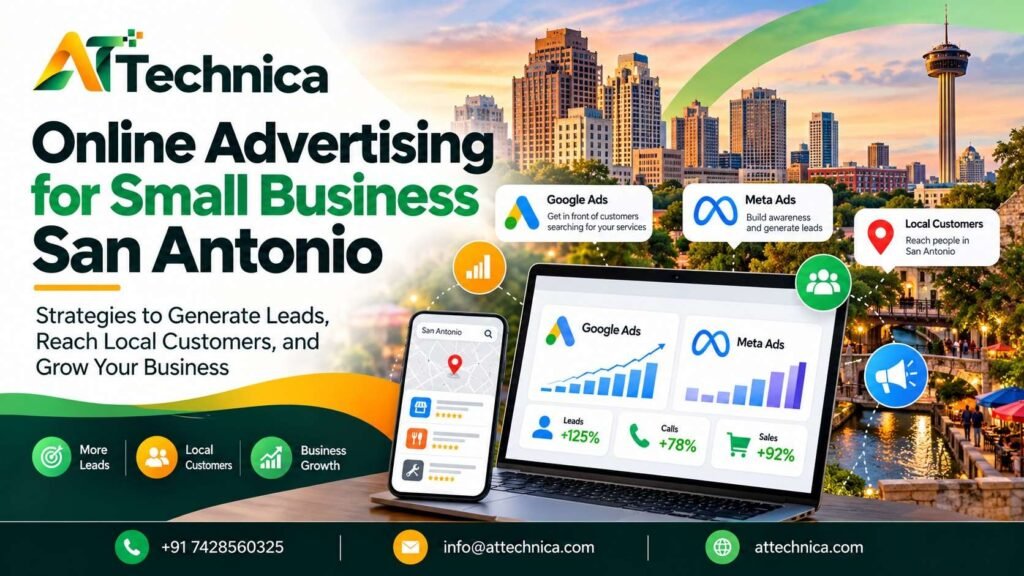
Running a small business in San Antonio means competing for attention in a market where customers often search online before choosing a service provider, visiting a store, or requesting a quote. Whether you operate a plumbing company, restaurant, dental practice, real estate business, retail store, or professional service firm, reaching the right people at the right time can make a measurable difference to your growth.
That is where online advertising for small business San Antonio becomes valuable. Instead of relying entirely on referrals or waiting for organic search traffic to grow, businesses can use paid search, social media advertising, local campaigns, and conversion-focused landing pages to reach potential customers with a relevant message.
However, successful advertising involves more than launching a campaign and increasing the budget. You need a clear target audience, a compelling offer, a suitable advertising platform, reliable conversion tracking, and a process for turning enquiries into paying customers.
This guide explains how San Antonio businesses can choose advertising channels, plan budgets, measure results, avoid common mistakes, and combine marketing with technology to build a more effective customer acquisition system.
Why Online Advertising for Small Business San Antonio Matters
Customers have different reasons for searching online. Someone looking for an emergency plumber may need a service immediately, while a person researching a new home or business software may compare several providers before making a decision.
A well-planned online advertising for small business San Antonio strategy should reflect these differences. It should reach customers based on their intent, location, interests, and stage in the buying process.
Here are some important advantages.
1. Reach customers with relevant intent
Search advertising can help your business appear when people search for services you provide. For example, a local HVAC company might target searches related to air conditioning repair, while a bookkeeping firm could target businesses looking for accounting support.
These searches can indicate stronger buying intent than general online browsing, although the quality of each lead depends on the query, offer, competition, and landing page.
2. Control where your budget goes
Paid advertising lets businesses set campaign budgets, choose geographic targeting, adjust bids, and pause underperforming campaigns. This gives small businesses more control than committing to a large advertising placement without clear performance data.
3. Measure actions that matter
With appropriate tracking, you can measure calls, form submissions, purchases, appointment requests, and other valuable actions. Google Ads offers conversion measurement tools to help advertisers understand which interactions follow their advertising activity. Google Ads conversion measurement.
4. Build a repeatable lead generation process
A strong campaign can become part of a broader acquisition system: advertising attracts visitors, a landing page explains the offer, tracking records conversions, and a follow-up process helps turn enquiries into customers.
The objective is not simply to generate clicks. It is to acquire qualified customers at a cost your business can sustain.
Which Online Advertising Channels Should You Use in San Antonio?
For online advertising for small business San Antonio, not every platform is suitable for every business. Your choice should depend on customer intent, buying behavior, budget, and the type of product or service you sell.
Google Search Ads: Reach People Actively Looking for Your Service
Google Search Ads can put your business in front of people searching for relevant products or services. This makes search advertising particularly useful when customers already understand their problem and want a solution.
For example, a San Antonio roofing company might test search terms related to roof repair, roof replacement, or storm damage inspections. A B2B software provider might target businesses searching for a specific type of software or service.
To improve performance:
- Group related keywords into tightly themed ad groups.
- Write ad copy that reflects the searcher’s needs.
- Use negative keywords to reduce irrelevant clicks.
- Match each ad to a relevant landing page.
- Track qualified calls, booked appointments, and submitted forms.
For online advertising for small business San Antonio, search campaigns can be a sensible starting point when your audience is actively looking for what you offer. Competition and cost per click will vary by industry and keyword, so test before committing a large budget.
Meta Ads: Reach Potential Customers on Facebook and Instagram
Meta Ads can help businesses reach people based on available audience signals, interests, behaviors, location settings, and engagement with advertising content. They can be useful for businesses that need to introduce an offer, demonstrate a product, promote an event, or generate enquiries.
Potential use cases include:
- Restaurants promoting a new menu or special offer.
- Fitness studios promoting introductory memberships.
- Real estate companies generating property enquiries.
- Retailers showcasing products through video and carousel ads.
- Service businesses building awareness and remarketing to eligible audiences.
Meta campaigns often depend heavily on the creative. Test different hooks, images, videos, offers, and calls to action. Measure lead quality as well as lead volume.
You can explore advertising options through Meta for Business.
Google Maps and Local Search Visibility
Local customers often look for businesses close to their location. A complete Google Business Profile can help eligible businesses appear in relevant local results and provide important details such as location, hours, contact information, and reviews.
Keep your business information accurate, select relevant categories, and maintain consistent details across your website and business listings. Google Business Profile is a local presence tool; paid advertising and organic local visibility are separate activities.
Google Ads also supports certain location-based advertising formats and objectives. Eligibility, campaign setup, and available features vary, so check the official Google Ads local advertising guidance.
YouTube and Display Advertising
YouTube and display campaigns can help businesses introduce their products, explain complex services, or reconnect with eligible audiences who have previously interacted with their website or content.
These channels may be useful for businesses with strong visual content, longer consideration periods, or a need to build awareness before customers are ready to buy.
However, impressions and video views do not automatically translate into sales. Use clear campaign objectives and evaluate whether the resulting traffic, conversions, or assisted interactions justify the spend.
SEO and Paid Advertising Together
SEO helps businesses build organic visibility over time, while paid advertising can provide more immediate opportunities to test offers and reach potential customers.
Combining both can reveal useful insights. Search query data may identify topics for future SEO content, while organic landing pages may help you understand which questions customers need answered before converting.
Paid advertising should not replace a long-term website and content strategy. Likewise, SEO alone may not meet every short-term lead generation requirement.
Advertising Channel Comparison
| Channel | Best use case | Main advantage | Potential limitation |
|---|---|---|---|
| Google Search Ads | High-intent service searches | Reaches people actively looking | Competitive keywords can be expensive |
| Meta Ads | Awareness, offers, and lead generation | Flexible visual creative and audience testing | Intent may be less immediate |
| Google Maps and local presence | Local discovery | Helps customers find business details | Visibility depends on relevance, eligibility, and competition |
| YouTube and Display | Awareness and remarketing | Visual storytelling and broader reach | Direct response may be harder to attribute |
| SEO | Sustainable organic discovery | Can generate ongoing unpaid visits | Takes time and consistent work |
The best choice depends on your business model. A service provider with urgent, high-intent searches may begin with Google Search Ads. A business introducing a new consumer product may benefit from Meta campaigns. Many companies eventually combine several channels after identifying which ones produce profitable customers.
How to Build an Effective Advertising Strategy
A successful campaign starts with a business objective rather than a platform.
Step 1: Define the result you want
Decide whether you want phone calls, quote requests, appointments, online purchases, store visits, or qualified B2B enquiries.
Avoid treating all leads as equally valuable. A campaign generating 50 unqualified enquiries may be less useful than one generating 15 enquiries from people who fit your target customer profile.
Step 2: Define your ideal customer and service area
Identify the customer type, problem, location, and buying trigger. For a local business, determine whether you serve all of San Antonio or only selected neighborhoods and surrounding areas.
Use location settings that match your actual service coverage. Review the platform’s location-targeting options and reporting rather than assuming every person who sees an ad is physically located in your target area.
Step 3: Choose the right offer
Your offer gives customers a reason to act. Depending on your business, it could be a consultation, inspection, product demonstration, appointment, quote, or introductory service.
Make the offer clear, credible, and consistent with what your team can deliver. Avoid unsupported claims, unrealistic discounts, and promises that your business cannot fulfill.
Step 4: Match the ad to the landing page
A relevant ad should lead to a page that continues the same conversation. If the ad promotes a specific service, the landing page should explain that service rather than sending every visitor to a generic homepage.
A strong landing page generally includes:
- A clear headline and description of the service.
- Benefits that address the customer’s problem.
- Evidence that helps establish credibility.
- A visible call to action.
- A short, easy-to-complete form where appropriate.
- Mobile-friendly design and fast loading.
- Accurate contact information and a privacy notice where required.
Step 5: Set up tracking before launch
Configure conversion tracking before spending significant money. Test that form submissions, calls, purchases, or appointment bookings are recorded correctly.
Google provides conversion tracking tools and guidance for measuring valuable actions.
Where appropriate, connect advertising platforms with analytics and your CRM. This can help you distinguish between a submitted form, a qualified lead, a booked appointment, and a completed sale.
Step 6: Test and improve
Launch with a manageable budget and review performance at regular intervals. Test one meaningful variable at a time where possible—for example, the offer, audience, keyword theme, headline, or landing page.
Give campaigns enough data to make useful decisions, while acting promptly if tracking is broken, irrelevant traffic is accumulating, or spending is clearly misaligned with your goals.
How Much Should a Small Business Spend on Online Advertising?
There is no single advertising budget that suits every San Antonio business. Your budget depends on the average value of a sale, profit margins, competition, conversion rates, sales capacity, and the amount you can afford to test.
A sensible starting budget should be large enough to collect useful data without putting essential business expenses at risk.
A hypothetical budget example
Suppose a local service business sets aside $1,200 per month for advertising.
| Metric | Hypothetical value |
|---|---|
| Monthly ad spend | $1,200 |
| Average cost per click | $4 |
| Estimated clicks | 300 |
| Landing page conversion rate | 5% |
| Estimated leads | 15 |
| Cost per lead | $80 |
These numbers are illustrative, not San Antonio market averages or a performance forecast. Actual results can differ substantially by industry, targeting, campaign quality, and offer.
In this example, the business would generate 15 leads at an estimated cost of $80 per lead. The next question is how many leads become paying customers and how much profit those customers generate.
If only one lead becomes a customer, the advertising cost per acquired customer would be $1,200. If five become customers, it would be $240 per customer, before agency fees, sales expenses, and other costs.
This is why online advertising for small business San Antonio should be evaluated against customer acquisition cost and profitability—not clicks or leads alone.
The Metrics You Should Track
Your reporting should connect advertising activity to business outcomes.
Cost per lead (CPL)
CPL is advertising spend divided by the number of leads generated. Define what counts as a lead before comparing campaigns, and separate spam or irrelevant enquiries where possible.
Customer acquisition cost (CAC)
CAC measures the cost of acquiring a customer. For a complete business view, include relevant sales and marketing costs rather than relying only on advertising spend.
Conversion rate
Conversion rate measures the percentage of eligible visitors or interactions that complete a defined action. Always specify the denominator and conversion event when comparing results.
Return on ad spend (ROAS)
ROAS compares attributed revenue with advertising spend. It can help assess revenue efficiency, but it does not automatically account for product costs, delivery costs, overhead, or profit margins.
Lead-to-customer rate
This metric shows how many leads become paying customers. It helps identify whether the main problem is advertising quality, sales follow-up, pricing, or the offer itself.
Review these metrics together. Low CPL is not necessarily a sign of success if the leads do not qualify or convert.
Common Online Advertising for Small Business San Antonio Mistakes to Avoid
Even well-funded campaigns can underperform when the fundamentals are overlooked. So here are some common mistakes to avoice while running your online advertising for small business San Antonio.
Targeting too broadly
Broad targeting can generate irrelevant clicks and enquiries. Align keywords, audiences, and geographic settings with the customers you can realistically serve.
Sending every visitor to the homepage
A generic homepage may not address the specific service, offer, or question that prompted a click. Create focused landing pages for important campaigns.
Optimizing only for cheap leads
Low-cost leads may have low purchase intent. Track lead quality and customer outcomes so that budget decisions reflect business value.
Ignoring mobile users
Many people browse and enquire through mobile devices. Check page speed, form usability, click-to-call functionality, and readability on smaller screens.
Failing to follow up
A campaign cannot compensate for slow or inconsistent sales follow-up. Establish a process for responding to enquiries, assigning ownership, recording outcomes, and following up appropriately.
Making changes without reliable data
Frequent edits based on a handful of clicks can make performance difficult to interpret. Use reliable tracking, a consistent evaluation period, and clear decision criteria.
Why Websites, Software, and Automation Matter for Online Advertising for Small Business in San Antonio
Online Advertising for Small Business San Antonio is only one part of customer acquisition. Your website, CRM, sales process, and communication systems influence what happens after someone clicks an ad.
For example, a business may generate enquiries successfully but lose potential customers because its form is difficult to use, staff cannot respond quickly, or lead information is not recorded consistently.
AtTechnica can support a connected approach to digital growth through performance marketing, website and software development, and customer communication technology. Depending on the business requirement, this may include:
- Campaign planning and optimization for Google Ads and Meta Ads.
- SEO, local SEO, and content strategy.
- Website and landing page development.
- Conversion tracking and analytics implementation.
- CRM and API integrations.
- Lead management and marketing automation.
- Business messaging through suitable channels, including SMS, WhatsApp Business API, email, and voice.
These services should be selected according to actual business needs. A small business may need only a well-structured search campaign and landing page to begin. Another may require CRM integration and automated lead follow-up to manage a larger enquiry volume.
The objective is to create a connected system that attracts relevant prospects, records their actions, and helps your team respond effectively.
How to Choose an Online Advertising Partner
When comparing agencies or marketing consultants, look beyond promises about traffic, rankings, or lead volume.
Ask prospective partners:
- How will you define and measure a qualified lead?
- Which campaigns and channels do you recommend, and why?
- Will conversion tracking be tested before launch?
- How will you report on leads, sales, and customer acquisition cost?
- Who owns the advertising accounts, analytics properties, and campaign data?
- How frequently will campaigns be reviewed and optimized?
- How will you communicate budget changes and explain underperforming results?
A reliable partner should explain the strategy, assumptions, limitations, and reporting process in plain language. Be cautious of guaranteed results without evidence or promises that ignore your industry, offer, sales process, and budget.
For online advertising for small business San Antonio, prioritize a partner that understands your objectives, measures meaningful conversions, and can explain how campaign decisions relate to business outcomes.
How AtTechnica Can Help
AtTechnica provides digital marketing and technology services designed to help businesses improve their online presence and customer acquisition processes.
Depending on your goals, support may include paid search campaigns, Meta Ads, SEO, local SEO, landing page development, analytics, website improvements, custom software, CRM integrations, and customer communication automation.
This combination can be useful when your growth challenges extend beyond advertising—for example, when you need to improve the website experience, connect lead forms with your CRM, or create a more consistent follow-up process.
Every engagement should begin with understanding your target audience, service area, budget, conversion goals, and current marketing setup. Recommendations should then be based on those requirements rather than assuming that every business needs the same channels or technology.
Visit AtTechnica to explore the company’s services and discuss your digital growth requirements. Any service scope, availability, pricing, or local presence should be confirmed directly with the company.
FAQ: Online Advertising for Small Business San Antonio
What is online advertising for small business San Antonio?
It refers to using digital advertising channels—such as Google Search Ads, Meta Ads, YouTube, and relevant local advertising formats—to reach potential customers in San Antonio. Campaigns may aim to generate calls, enquiries, bookings, purchases, or brand awareness.
Which online advertising platform is best for a small business in San Antonio?
The best platform depends on your customer and offer. Google Search Ads may be suitable when people actively search for your service. Meta Ads may work well for visual offers, awareness, and lead generation. Testing and conversion data should guide the final decision.
How much should a San Antonio small business spend on digital advertising?
There is no universal amount. Start with a budget that your business can sustain, estimate the economics of acquiring a customer, and test the campaign before scaling. Evaluate the budget against qualified leads, customer acquisition cost, and profitability.
How long does it take to see results from online advertising?
Paid campaigns can begin generating traffic after launch, but meaningful results depend on competition, conversion tracking, campaign quality, and sales follow-up. Allow time to collect reliable data while correcting tracking issues and clearly irrelevant traffic promptly.
Do small businesses need a website to run ads?
Not every campaign requires a traditional website, but a relevant, trustworthy destination often improves the customer experience and gives businesses more control over messaging and measurement. The appropriate destination depends on the platform, campaign objective, and business model.
Can online advertising work alongside SEO?
Yes. Paid advertising can help generate traffic while SEO builds organic visibility over time. Shared insights about customer questions, search intent, and conversion performance can inform both strategies.
How can I tell whether my advertising is profitable?
Track actual sales or revenue where possible, along with advertising costs and other relevant expenses. Monitor cost per qualified lead, customer acquisition cost, conversion rates, and profit—not just clicks, impressions, or form submissions.
Conclusion: Online Advertising for Small Business San Antonio
A successful digital advertising strategy starts with a clear business goal, a well-defined audience, a relevant offer, and a reliable way to measure conversions. The right channel mix depends on what customers are searching for, how they make buying decisions, and what your business can profitably deliver.
With online advertising for small business San Antonio, the objective should be to build a measurable customer acquisition process—not simply increase website traffic or collect more leads. Start with a focused campaign, track the complete journey from click to customer, improve the landing page and follow-up process, and scale only when the results support it.
AtTechnica can help businesses explore the marketing and technology components of that process, from paid campaigns and SEO to websites, tracking, integrations, and customer communication automation.
Ready to improve your digital marketing strategy? Contact attechnica.com to learn more and discuss the services that fit your business goals.
Read Other Blogs
AI Search Marketing DC: How Businesses Can Get Found in AI Search
Crew CloudySocial: What It Is, How It Works, and What You Should Know